


Cultural Deepdive Kalinago People
The Last Indigenous People of the
Eastern Caribbean Are Still Here — And They Want You to Know Their Story
There is a version of the Caribbean that most people see: the turquoise water, the white sand, the rum punch at the swim-up bar, the zip line tour that everyone in line has already done somewhere else. That version of the Caribbean is real, and there is nothing wrong with it. But there is another Caribbean underneath it — older, stranger, and considerably more interesting — that most visitors leave without ever finding.
The Kalinago Territory in Dominica is that other Caribbean.
A People Who Should Not Exist (and Do Anyway)
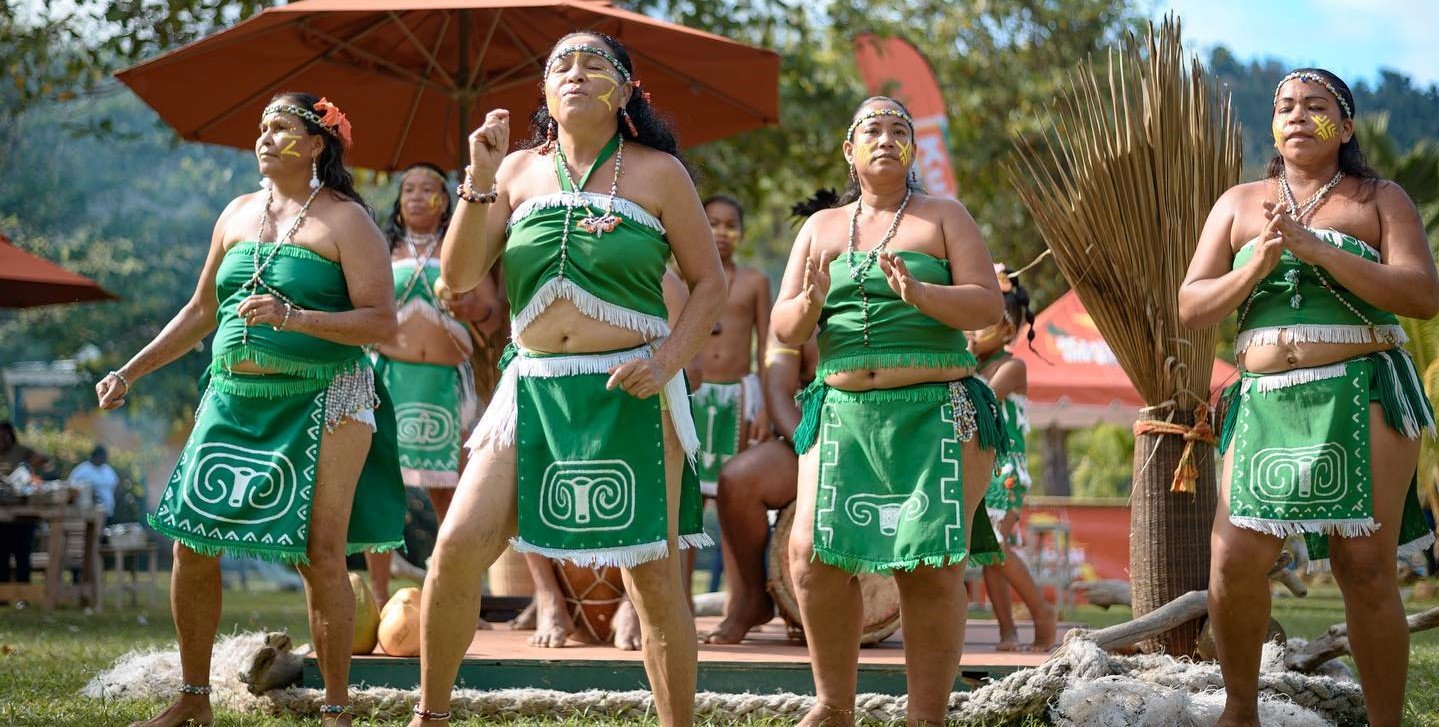
The Kalinago — known historically as the Caribs, though that name carries the weight of colonial misrepresentation — were the dominant people of the Lesser Antilles when European ships arrived in the 15th century. What followed was the familiar pattern: conflict, disease, displacement, and the systematic dismantling of cultures that had existed for centuries without needing European categorization.
In most of the islands, the Kalinago were gone within two centuries of contact. In Dominica, they held on. The island’s rugged interior — mountains that kept colonial agriculture unprofitable and terrain that resisted easy domination — gave the Kalinago space that other islands didn’t offer. By the early 20th century, the British colonial government had recognized a formal Carib Reserve. Today that territory covers approximately 3,700 acres on the northeastern coast, and it is home to what historians and anthropologists generally agree is the last continuous Kalinago community in the Eastern Caribbean.
They are not a remnant. They are a people.
What Kalinago Tours Is, and Why It Matters
Kalinago Tours was founded on a straightforward premise: no one knows the Kalinago Territory like the Kalinago do. As the only tour company based inside the territory itself, they operate from within the community — their guides are from there, their connections to the sites they visit are personal, and the experiences they offer are not constructed for tourism. They are windows into something that exists independently of the tourism economy, and that independence is exactly what gives the tours their quality.
Certified guides accompany every tour. Complimentary refreshments are standard. The packages are designed to meet different kinds of visitors where they are — the cruise passenger with four hours, the family on a week-long stay, the group that wants full cultural immersion over three days and two nights.
The Adventures Package: Three Levels of Depth
The flagship offering is the Kalinago Adventures tour, which comes in three-hour, five-hour, and seven-hour configurations. Each level builds on the last, and all of them begin with the same foundation: an introduction to Kalinago life as it is actually lived, not as it is performed for visitors.
The three-hour version covers a legendary site, the remarkable Salybia Church, and a hands-on cassava bread-making session that — no matter how skeptical you arrive — will hold your attention completely.
The five-hour version adds a visit to a Kalinago artisan and a working farm. The basket weaving you will see in that artisan’s workshop is not decorative. It is technical knowledge preserved through practice, with a visual vocabulary of patterns that encode cultural meaning the way writing encodes language. The farm visit, meanwhile, grounds the experience in the present — a Kalinago farmer explaining how community self-sufficiency works, how the land is managed, what grows there and why.
The seven-hour version adds two things that, together, make it the most complete experience available: a meeting with additional Kalinago cultural icons and a traditional lunch prepared in the territory. That meal — eaten in the place where it was grown and cooked — is, for many visitors, the moment the entire experience crystallizes.
The Sites: What You Will Actually See
Les Caliere Tete Chien
The name means ‘the lair of the dog-headed serpent’ in Kalinago oral tradition. It is a geological formation on the coast that Kalinago legend associates with a spirit animal of significant cultural importance — a figure that appears in stories told across generations, its details consistent in ways that suggest the narrative has been maintained with care rather than allowed to drift.
Standing at the site with a Kalinago guide explaining its significance, you understand something that guidebooks rarely convey: that mythology is not separate from landscape. The Kalinago read the land as a text, and Les Caliere Tete Chien is one of its most important passages.
The Salybia Church
A Roman Catholic church, technically. But the Kalinago who built and decorated it made a choice that students of postcolonial history will find quietly electrifying: they built it to look like them. The columns carry Kalinago motifs. The painted figures in the interior reflect Kalinago faces and forms, not the European iconography that characterized missionary-period church art across the Caribbean.
It is a small building. The act of cultural assertion it represents is not small at all.
The Artisans
Kalinago basket weaving is one of the Caribbean’s most technically sophisticated craft traditions. The materials — larouma reed, various bark fibres — are processed by hand before the weaving begins. The patterns woven into finished baskets are not ornamental; they are meaningful, with different designs associated with different Kalinago families, ceremonies, and historical narratives.
The artisans you visit on a Kalinago Tours experience are not demonstrating a craft. They are sustaining a language. What you purchase from them is not a souvenir. It is a contribution to that language’s survival.
The Farm
Food sovereignty is, in the Kalinago context, not an ideological position but a historical strategy. Communities that could feed themselves from their own land had resilience that communities dependent on external supply chains did not. The Kalinago farm visit shows this philosophy in practice: a diverse range of tropical provisions grown on a hillside, managed by community members who understand the land in the way that only long relationship produces.
For urban visitors — and most tourists are urban visitors — this stop is often the most quietly revelatory of the day.
The Homestay Option: Going Further
For visitors who want more than a day tour, Kalinago Tours offers homestay accommodation within the territory. Staying inside the Kalinago community overnight — eating meals with local families, waking up inside the territory rather than arriving into it — changes the texture of the experience in ways that are difficult to articulate but easy to feel.
The Weekend Rendezvous package combines accommodation, all meals, transportation, and full tour guide services into an all-inclusive three-day, two-night experience. It is designed for groups of ten or more and represents the deepest engagement with Kalinago culture that the company offers.
A Note on Responsible Tourism
The Kalinago Territory is a living community, not a heritage site. When you visit with Kalinago Tours, you are a guest in someone’s home — a very large home with a 3,700-acre yard, but a home nonetheless. The guides understand this and calibrate the experience accordingly. Certain sites and stories are shared; others are not, because they belong to the community in ways that tourist disclosure would compromise.
This is not a limitation of the experience. It is a sign of its integrity.
Purchase from the artisans. Tip your guide. Leave the territory in the condition you found it. The community has been here for centuries; the purpose of your visit should be to add something to that continuity, not subtract from it.
Planning Your Visit: The Information You Actually Need
Phone: +1 767-285-0595
Email: info@kalinagotours.com
Website: www.kalinagotours.com
3-Hour Tour: From US$35 per person (group 15–20) | Starts 10 AM
5-Hour Tour: From US$40 per person (group 15–20) | Starts 9 AM
7-Hour Tour: From US$50 per person (group 15–20) | Starts 9 AM
Weekend Rendezvous: 3D/2N all-inclusive | Min 10 pax | Ask for quote
Cruise Package: 6 Hours | Min 10 pax | Designed for port-day visitors
Tours begin at the times listed above unless alternative arrangements are agreed in advance. No modifications to packages during the tour — if you want changes, discuss them before arrival. All tours include a certified guide and refreshments. Transport within the territory is available; transport from outside the territory carries an additional cost.
“You deserve the experience. — Kalinago Tours”
That’s the tagline. Having spent time in the Kalinago Territory with their team, it doesn’t feel like marketing. It feels like an accurate description of what they’re offering: an experience that most Caribbean visitors never access, delivered by the people best qualified to give it, in a place that has earned the right to be taken seriously.
The Kalinago are still here. They are worth your time.Experience the real Caribbean → www.kalinagotours.com |

Wp-travolo
Deauty products Lorem ipsum dolor sit amet, consectetur adipisicing the Lorem ipsum dolor sitamet consectetur adipiscing eiusmod
Wp-travolo
Deauty products Lorem ipsum dolor sit amet, consectetur adipisicing the Lorem ipsum dolor sitam
Wp-travolo
Deauty products Lorem ipsum dolor sit amet, consectetur adipisicing the Lorem ipsum dolor sitamet consectetur adipiscing eiusmo